
preloader

Project overview

A strategic look into Alldone’s task management engine, focusing on solving the bottleneck of agile team collaboration.

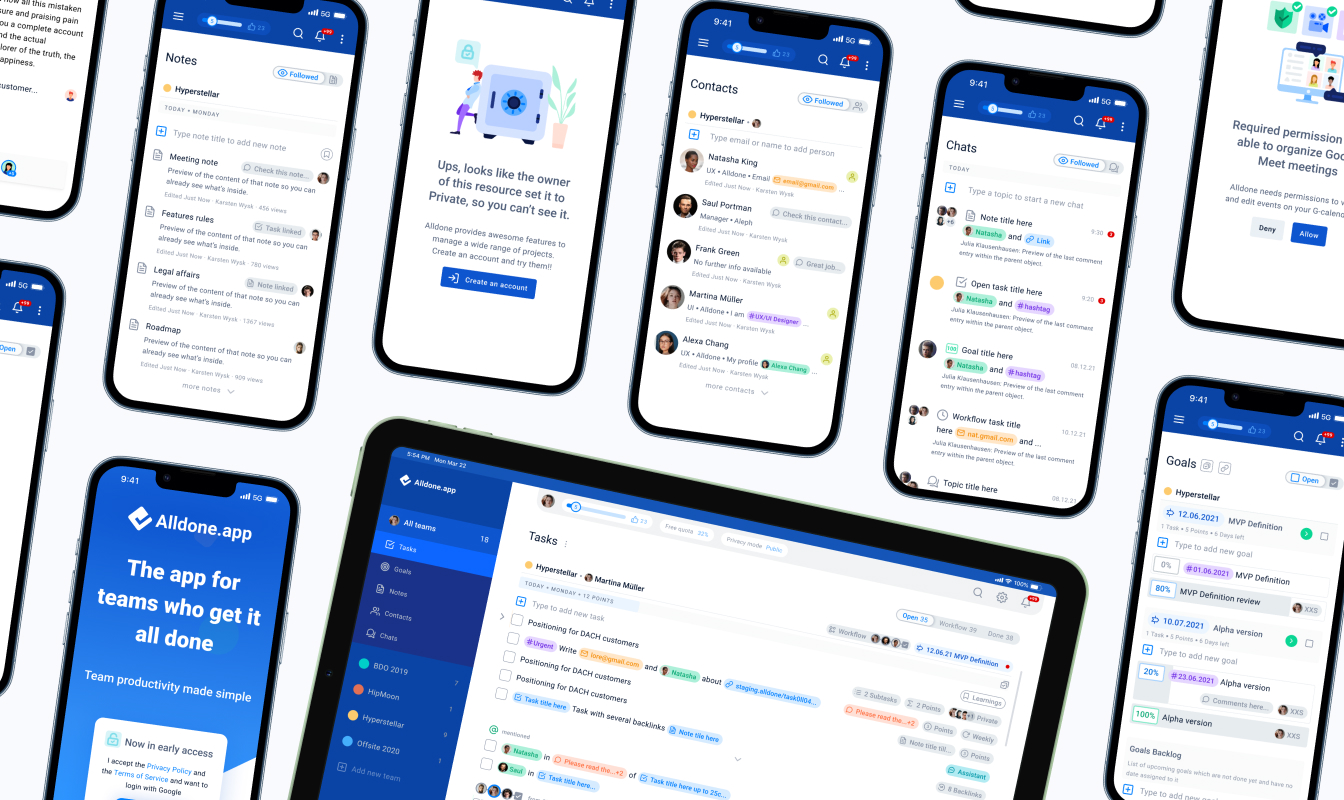
Project overview mockups

The product

A gamified agile ecosystem engineered for high-performance teams. Built on a culture of continuous dogfooding, Alldone serves as its own development engine—allowing us to validate complex workflows and architecture in real-time through our own internal friction and successes.

Responsibilities

As Project Manager and Lead Designer, I owned the end-to-end product lifecycle—from ideation and motion design to a scalable Figma Design System. I led feature documentation and testing, bridging the gap between high-level strategy and final development.

The problem

Managers at Alldone faced a critical bottleneck: a decentralized review process. To approve work, they had to manually navigate individual member boards, creating a high-friction workflow that delayed project velocity and increased cognitive load.

The goal

To architect a centralized review system that eliminates management bottlenecks. The objective was to transform a fragmented, manual oversight process into a streamlined workflow, drastically reducing the time managers spend validating team contributions.

My role

As Project Manager and Lead Product Designer, I spearheaded a team of four developers while owning the entire design lifecycle. Being the sole designer, I transitioned seamlessly between high-level project management and hands-on execution—covering everything from UX strategy and systems architecture to UI and motion design.

Project tenure

From December 2019 to June 2022, I served as the driving force behind Alldone's design and project management. Over these 30 months, I transitioned the platform from a core idea into a robust tool used to manage its own complex development lifecycle.
Getting to know the user

User research summary

Alldone has the particularity of being an app for managing agile teams and was developed by an agile team, so the Product Manager decided to use the MVP version to record and manage its development process. This way the team was end user at the same time and was able to find pain points at an early stage.

Pain points

Using time inefficiently

Teams members with managing roles had to use long sessions to review other members tasks, the normal flow made them go forth and back among boards to check all tasks.

Hard to track tasks progression

Users were not able to know the current status of tasks and the feedback from managers.

Lack of coherent organization

Team members had to move back tasks which were moved to Done section when some requirement had not been accomplished, so those task were in a section not representing its status.

Inaccurate statistics

Managers had the daily task of reviewing other members' tasks, but the time used on it was not tracked. This resulted in an inaccurate time spent by managers at the end of sprints.

Objective

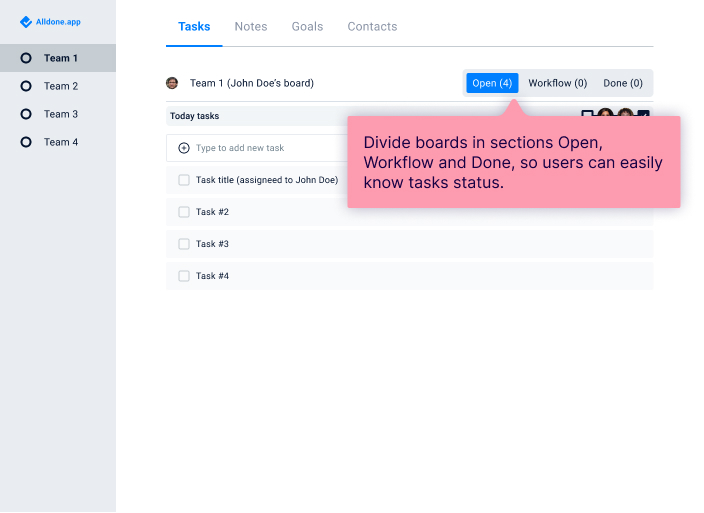
Adding a feature to organize tasks in a manner that they are moved to managers boards once assignees mark them as done. Also, managers need to be able of estimating tasks they review, so the time spent on it is counted in statistics. This feature will be called from now on “Workflows”.

Starting the design

Exploration

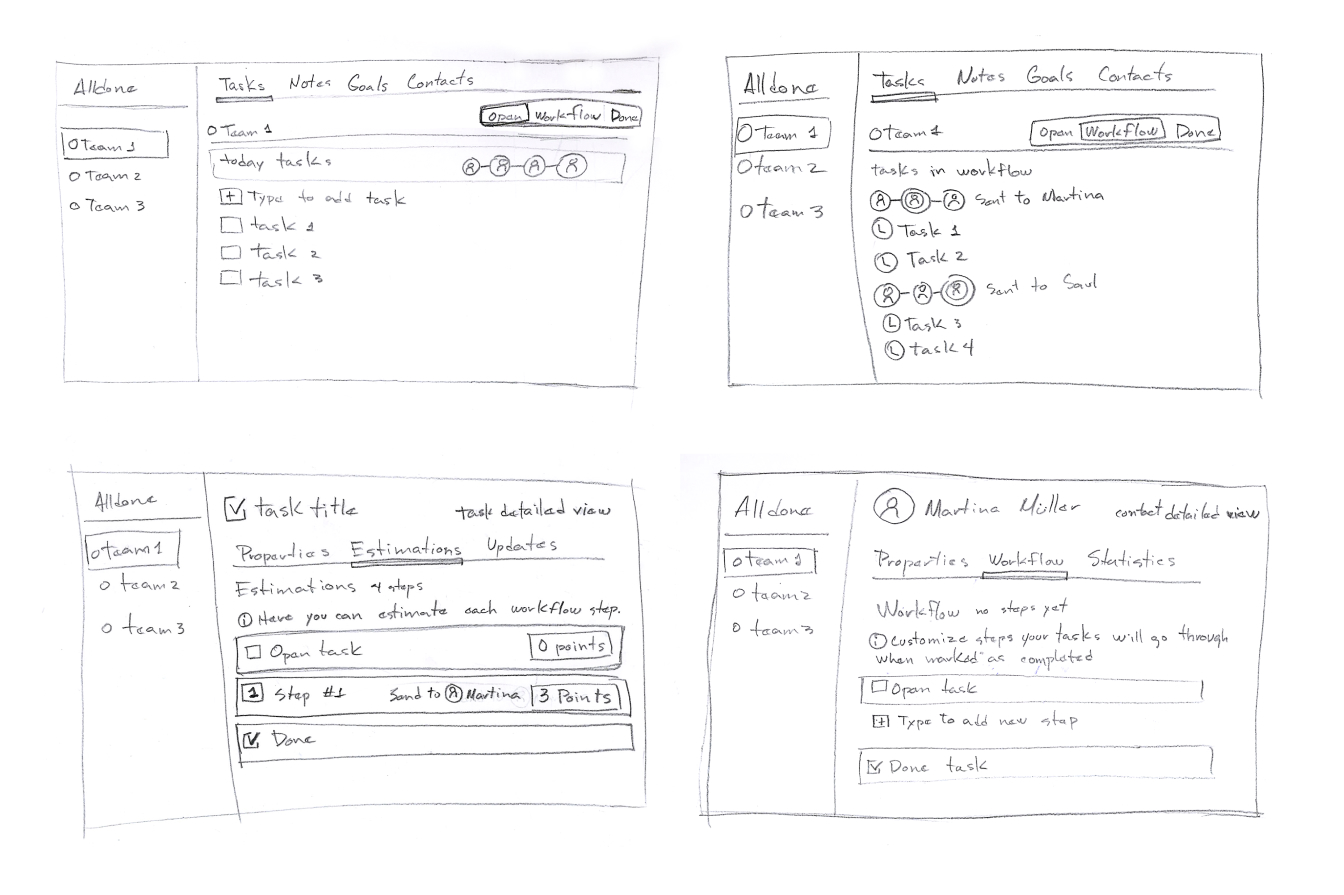
Paper wireframes exploration

This is a sample of the exploration made to find a flow for the creation of “Workflows” for team members.

Digital wireframes

Low-fidelity prototype from assignee's point of view

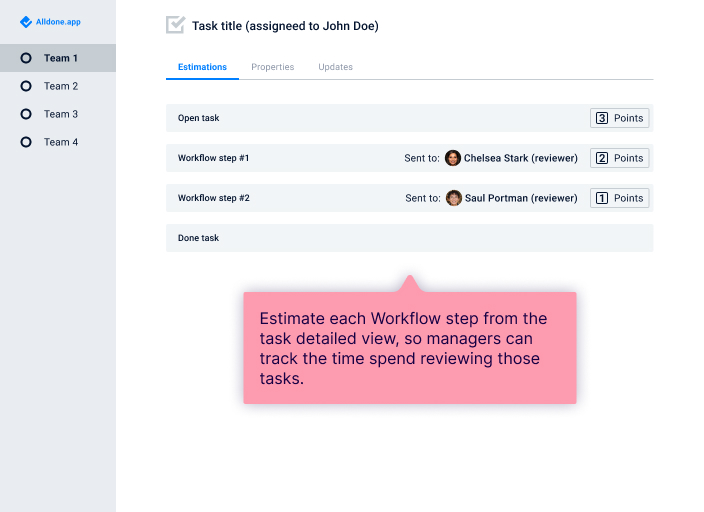
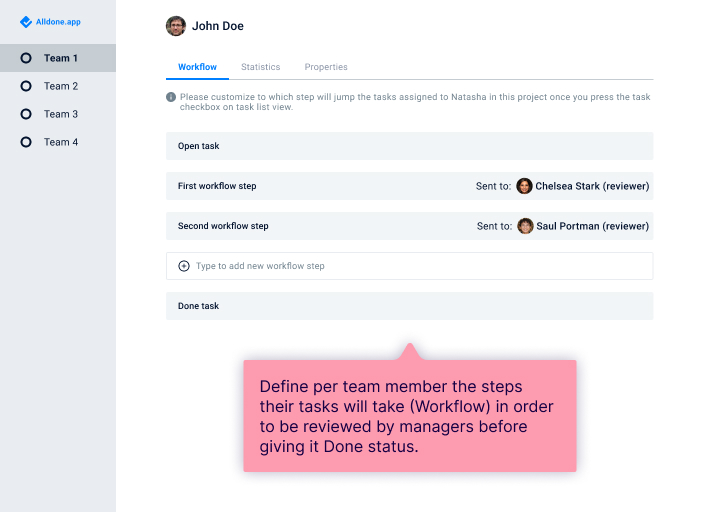
This flow describe how users can set several steps of a Workflow and estimate each of them so corresponding reviewers (managers) can track the time spent reviewing.

Low-fidelity prototype from reviewer's point of view

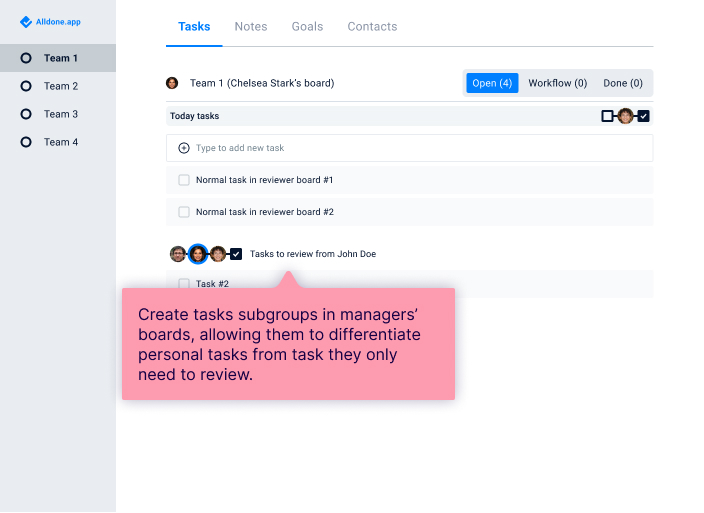
This flow define how tasks coming from assignees will behave and be shown in reviewer’s board.

Usability study findings

Using the low-fi prototypes was posible to test the aproach. Thanks to figma feature of sharing prototypes via link it was a straight forward process since users coud try out from every where.

1Life cycle of tasks was reduced and users could keep track of task when they were in reviewers boards.

2For managers, it was possible to report time spent reviewing other members tasks.

3The estimation points concept was not understood since it works using time ranges and not fixed time value.

4Users tried to manage Workflow steps directly from tasks detailed views, but this is not available as a feature.

Refining the design

High-fidelity prototypes

High-fidelity prototype from assignee's point of view

This flow describe how users can set several steps of a Workflow and estimate each of them so corresponding reviewers (managers) can track the time spent reviewing.

High-fidelity prototype from reviewer's point of view

This flow define how tasks coming from assignees will behave and be shown in reviewer’s board.

Outcomes

Takeaways

Impact

As an outcome, the Alldone.app went one step further to become a fully professional tasks management system. The team contribution was decisive for the product to be valued in 2 000 000 euros before its release.

What I learned

This project is the biggest and longest I have worked on, and the one that has taught me the most. Here I got valuable Design Systems experience and strengthened my leadership and communicative skills.

Next steps

1Taking into account the usability study findings, the estimation concept needs to be revisited and interate on it.

2The Workflow feature was a success, but it can be improved by unifying the place to edit them or allow managing them directly from tasks detailed view.

Check other works